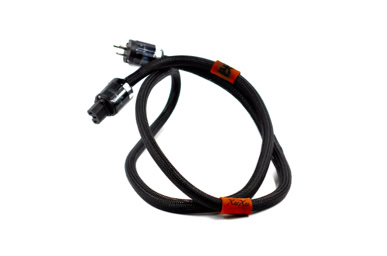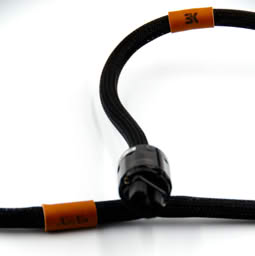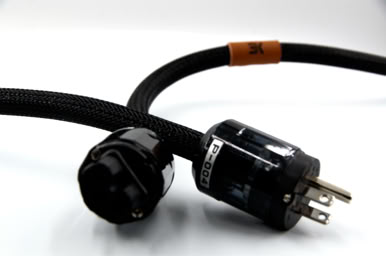
The XerXes Reference Power Cord is engineered as a true AC transmission line, directly addressing the current delivery, grounding, and noise issues that limit many systems.
Three identical conductors are used in a fully symmetrical geometry, so Line, Neutral, and Ground share the same high-quality materials and electrical behavior. This preserves current capacity and minimizes voltage drop under load—crucial for Class A/A‑B amplifiers, powered subs, and dynamic systems—while providing a stable, low-impedance ground reference instead of a compromised “afterthought” conductor.
To combat modern RF and power-line contamination, XerXes integrates our proprietary RJ420 noise dissipation network. This passive circuit is parasitic only to noise, not to the AC itself: it shunts unwanted high-frequency and common‑mode energy away from the component’s power supply without restricting voltage or current flow.
In practice, clients consistently report immediately audible gains: more low-level detail, tighter imaging, greater gravitas and impact, and a sense of increased speed and ease—evidence that the component is finally being fed the clean, stable power it was designed to use.
Conductor: Silver lattice
Effective Wire Gauge: 12
Dielectric: multi-modal with varying electronegativity
Shielding: EMI/RFI internal and external
Connector Bond: Compression
Distortion preemption: Directional passive energy network
Geometry: Bilateral symmetry
Base Configurations:
Equipment ingress
Power supply line connector (wall/power strip):
Enklein a division of Audio Union International LLC copywrite 2025
Lifestyle cabling and power products
Fundamental Building blocks
High Performance
Reference Level
Boundless possibilities through Technology
Reference grounding system for analog and Digital components
Reference power delivery system with 6 ports of exceptionally quiet system grounds
State-of-the-art Current and Voltage delivery with industry-leading technology for a stable reference system and chassis ground.
Cable families
Power appliances