Analog interconnects face very different demands depending on where they’re used. Most line‑level components operate at relatively high signal levels, while phono cartridges work at extremely low levels where noise and small electrical mismatches become critical.
In both cases, the key electrical properties are impedance, capacitance, and inductive reactance. These interact with the input and output stages of your components, which can vary widely—especially when you mix solid‑state and tube gear. Poorly controlled cable parameters can roll off high frequencies, alter dynamics, or shift tonal balance.
There is also the issue of signal reference. An analog waveform swings positive and negative around a “zero” point. If two components don’t share a stable, consistent reference—because of DC offsets or differing grounding schemes—small DC errors and noise can ride on the audio signal, increasing distortion and reducing clarity
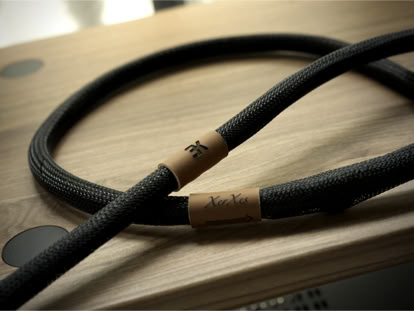
The XerXes Reference Analog Interconnect is engineered with a defined signal direction, so induced noise and parasitic energy are steered away from the active audio path as it moves downstream toward your amplification and speakers.
Its construction uses carefully chosen, multi‑layer dielectric and shielding materials, some strongly electronegative, others deliberately inert, to isolate each conductor from near‑field distortion, capacitive coupling, and external interference. This keeps cable‑induced reactance and noise to an absolute minimum.
In practice, the audible results are immediate: faster perceived attack and release, greater dynamic contrast, tighter image focus, and fully preserved low‑level harmonic detail. XerXes Reference doesn’t just pass signal; it helps create an immersive, highly resolved listening environment that feels coherent and alive.
Conductor: Silver lattice
Effective Wire Gauge: 18
Dielectric: multi-mode with varying electronegativity
Shielding: External EMI/RFI with multilayer internal decoupling
Connector Bond: Exothermic high-temperature
Distortion preemption: Directional passive energy network
Geometry: Bilateral mirror image for optimal signal retention
Base Configurations:
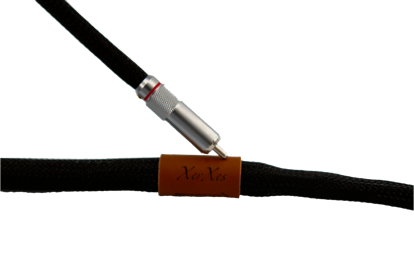
RCA interconnects
XLR interconnects
Phono interconnects
Enklein a division of Audio Union International LLC copywrite 2025
Lifestyle cabling and power products
Fundamental Building blocks
High Performance
Reference Level
Boundless possibilities through Technology
Reference grounding system for analog and Digital components
Reference power delivery system with 6 ports of exceptionally quiet system grounds
State-of-the-art Current and Voltage delivery with industry-leading technology for a stable reference system and chassis ground.
Cable families
Power appliances