Ethernet is a packet-based, asynchronous protocol designed for data integrity, not time-critical audio. In typical CAT8 implementations, several technical challenges directly affect high‑performance streaming:
Collision / contention behavior and timing variance
On shared or congested segments, simultaneous transmit attempts cause collisions or contention events. Although modern Ethernet uses switching and buffering to mitigate this, backoff algorithms, queueing, and retransmission introduce variable latency and packet‑arrival jitter. While the data payload is eventually delivered intact, these timing variations shift the workload to the endpoint buffers and clocks. In an audio context, that added variability can increase processing noise and jitter at the streamer or DAC interface.
Common‑mode noise and floating reference potentials
Many consumer routers, switches, and networked audio devices run from 2‑wire supplies (wall‑warts or figure‑8 IEC), with no safety ground and effectively floating reference planes. This makes them more susceptible to common‑mode RF and switching noise riding on the twisted pairs and shields. Differences in reference potential between devices allow noise currents to flow over the cable and into the PHY and clock domains, increasing jitter, modulation noise, and the probability of marginal edge detection—even when the packet CRC remains valid.
Together, these factors create a scientifically measurable problem: elevated common‑mode and RF noise, variable timing at the physical layer, and increased stress on local clocks and buffers. For high‑resolution audio streaming, that means a harder‑to‑stabilize digital interface, greater susceptibility to jitter, and more opportunity for subtle but audible degradation—even when the data itself remains bit‑correct.
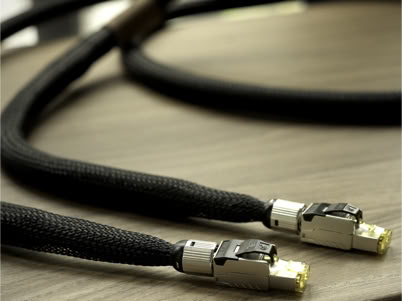
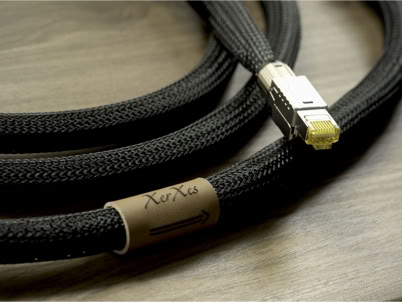
The XerXes Reference Ethernet system is engineered to tackle the physical‑layer issues that affect high‑performance streaming: timing variability, common‑mode noise, and unstable reference potentials.
Controlled grounding and reference
XerXes uses a directional ground network that lets you define a preferred grounding orientation within your network. Deployed across one or more links, it helps establish a more consistent signal reference between devices, reducing common‑mode noise currents that would otherwise ride along the cable and into clocks and PHYs.
Integrated noise dissipation (RJ420)
The RJ420 noise‑dissipation scheme is built into the connector/cable interface to drain RF and parasitic energy away from the data pairs. By lowering the noise floor at the physical layer, it reduces the likelihood of marginal edge detection and false collision/contension behavior, easing the workload on buffers and clocks in streamers and DACs.
Beyond CAT 8 compliance
XerXes not only meets but exceeds Category 8 electrical and bandwidth requirements, ensuring tightly controlled impedance, low crosstalk, and high‑integrity high‑speed data transmission. This provides a stable, low‑error link even in electrically noisy environments.
The result is a highly flexible, hand constructed CAT8 class cable that delivers measurably robust network performance and subjectively cleaner, more coherent streaming music.
Conductor: Copper lattice
Effective Wire Gauge: 22
Dielectric: ETFE with varying electronegativity
Shielding: EMI/RFI internal and external
Connector Bond: Compression
Distortion preemption: Directional passive false collision detection avoidance system
Geometry: Bilateral symmetry with foil-wrapped and isolated conductor pairs
Base Configurations:
Cable families
Power appliances
Enklein a division of Audio Union International LLC copywrite 2025
This website makes use of cookies. Please see our Privacy Policy for details.