-
Menu
-
Cable Family
-
Power Appliances
-
Technology
-
Contact
-
Media
-
About
-

Speaker cable design is fundamentally different from line‑level analog or digital because the cable is operating as part of a power delivery network, not just a signal link. The challenges are rooted in how real amplifiers, real speakers, and real cables behave under dynamic, wide‑band load conditions.
Key scientific challenges include:
Together, these factors make loudspeaker cabling one of the most scientifically demanding links in the chain. To approach an “ultimate” design, the cable must behave as close to electrically inert as possible across frequency and time—minimizing its own R, L, C, and group‑delay signatures so the amplifier and loudspeaker can interact with each other, rather than with the cable between them.
SHT speaker cables are engineered from the ground up to address the real, measurable problems outlined in the designed challenges.
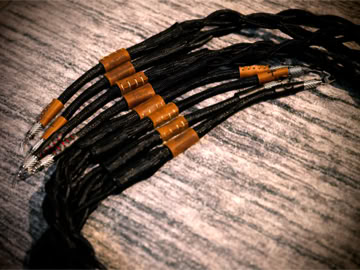
The SHT speaker cable’s core begins with a purpose‑built, multilayer dielectric system that isolates every conductor from high density near field effects, where electric and magnetic fields are still forming and most prone to chaotic interaction. By tightly controlling the local field environment, SHT reduces unwanted inductive and capacitive coupling, stabilizing R, L, and C behavior over frequency and time.
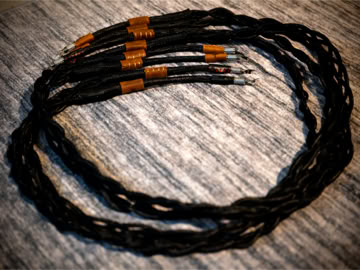
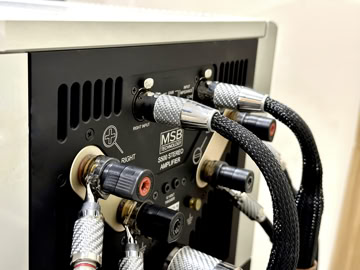
The positive and negative poles between amplifier and speaker are fully segregated: each connection is realized as two physically separate cables. This geometry minimizes mutual inductance and crosstalk between conductors, reduces loop‑area effects that can invite noise, and helps maintain consistent impedance under dynamic load. It also means our clients can interchange amplifiers and speakers without worrying about marginal stability or “synergy” band‑aids. The SHT speaker cable is designed to be as electrically invisible as possible to both amplofier and speeaker.
A trio of external filters, including extended copper anodes, is deflty integrated to eliminate both radiated and conducted noise. These elements are tuned to absorb and redirect destructive high‑energy fields, whether originating inside the system or from the surrounding environment. Mitigating any disruptive effects before they can enter the signal path as modulation, ringing, or HF hash
Taken together, these measures allow SHT speaker cables to behave as an inert link in the amplifier–loudspeaker interface: maintaining stable impedance, minimizing reactive loading, reducing group‑delay irregularities, and draining parasitic energy away from the music. Thus creating an immersive listeng evironment never realized before.
All of this technology is delivered in a flexible, client‑friendly, ultra‑high performance package that lets your electronics and loudspeakers define the sound; not the cables interconnecting them.
Enklein a division of Audio Union International LLC copywrite 2025
Cable families
Power appliances
This website makes use of cookies. Please see our Privacy Policy for details.